Growing up, Shanna didn’t realize she was living with progressive hearing loss, spending much of her life guessing conversations and relying on lip reading to get by. When a sudden change took away the remaining hearing she depended on, she pursued a cochlear implant—an experience that dramatically improved her speech understanding and renewed her sense of possibility. Today, Shanna shares how better hearing helped her reconnect with sound, confidence and lifelong goals. Read Shanna’s story below:
“I received a diagnosis of progressive bilateral hearing loss two decades ago. The deafness had likely been around a long time. It was the second time in my life I’d met with an audiologist. The first time was when the audiologist told me as a kid to pay attention.
I was six years old. The listening lab in kindergarten class was a semi-circle table with headsets worn by classmates. The objective was to listen to an audio story and then discuss with the teacher. The story’s words were a bunch of aahs and oohs mumbled by a female voice. ‘What was she saying? Why did the other kids know what to discuss with the teacher after the audio story ended and I didn’t?’
 Growing up guessing what was being said
Afterward I told my parents, or maybe my teacher did. I remember going to an audiologist’s office and being given headphones to wear in a listening booth. Instead of words that sounded like aahs and oohs, I heard a few beeps. Every time I heard a beep, I pushed a button on a device that looked like a game controller. It was like a game that I wanted to master. When I didn’t hear any beeps, I waited about three seconds and pushed the button anyway.
‘Your daughter’s hearing is normal,’ is what the audiologist told my mom. ‘She just needs to pay attention.’
I won the game!
Childhood was like that: part of a guessing game as to what people were saying or what sounds I heard and where they came from. I remember my family saying I walked and talked really loud, but that didn’t make any sense because I couldn’t hear my own footsteps and I didn’t intend to shout.
I remember friends asking why I didn’t answer to my name from several feet away when I was looking at them, but I never heard my name. People from behind bumped into me in crowded places, and I didn’t know they were behind me until I heard the mumbled words that became loud like they were shouting at me.
It was a game of figuring out what people were saying or why they were mad at me. It was making sense of jumbled words and frustrations that didn’t make any sense.
My hearing loss was progressing
One of the complexities of progressive hearing loss is you never know when you’ll no longer hear.
That happened to me twenty-four years after a diagnosis of bilateral sensorineural hearing loss. After a bout with a virus, I journeyed into this bewildering world of not hearing sounds I used to hear.
 I used to be able to have phone conversations wearing hearing aids. I used to have conversations with people if they sat close and near my better hearing ear.
Lip reading allowed the conversations to flow, with a few requests of ‘could you repeat that?’ Hearing aids also empowered my ears to hear consonant sounds that are common to speech: the ‘th’ and ‘s’ sounds, all of the ‘wh’ questions.
One night lying in bed, I felt feverish, my head approaching a migraine. After some sleep, I woke the next morning to no fever or migraine but a sense of fullness in my left ear, my better hearing ear. The ear I ensured was facing a person’s mouth as they talked with me. The ear from which I heard the morning alarm clock. The ear that had just enough hearing to benefit from a hearing aid and my ability to read lips. I could no longer hear in this ear.
Sure, there were some muffled sounds and mumbled speech I could still make out with the ear. But people’s words became unintelligible.
I remember my husband, a soft-spoken person, sitting ten inches from my better ear while I wore both hearing aids. Words that I once could hear from him were now garbled, like an unknown language I could not understand.
Choosing a hearing solution – a cochlear implant
After consulting with two audiologists and an ear, nose and throat (ENT) doctor, I was approved for cochlear implant surgery in 2025. Prior to the procedure, my unaided hearing provided only seven percent of speech comprehension.
Two weeks after surgery, my Cochlear® Nucleus® 8 Sound Processor was activated. It was initially programmed at level one or ‘comfortably loud’ according to a sound chart. Voices, at first, sounded robotic with a reverberating echo.
As my brain adjusted to hearing sounds in a different way and deciphered meaning from the sound, I transitioning to multiple different settings my audiologist provided.
It was at my 30-day check-in appointment that I transitioned to an advanced listening program, which my audiologist explained is closely associated with a comfortable hearing volume that is not too loud or soft.
My cochlear implant (CI) came with a remote control and the ability to connect to the Nucleus Smart App1, allowing me to adjust the programs and volume directly from my cell phone.
At the 30-day check-in appointment, I also received a new hearing aid for my un-implanted ear that was capable of being synched with the CI so that I could hear via Bluetooth® using both devices.
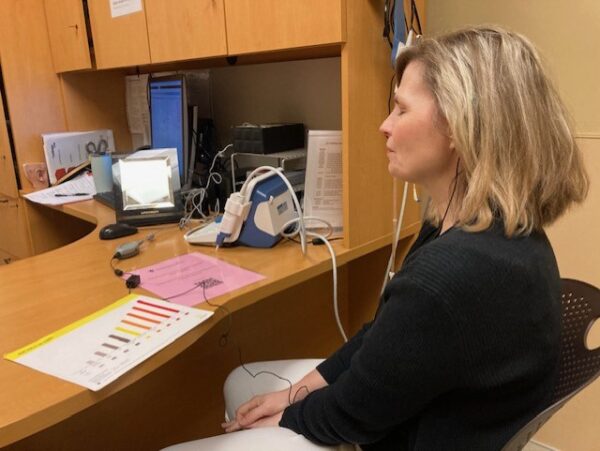
The audiologist took me into a sound booth and tested me using the previous test I had completed prior to surgery and scored seven percent in speech comprehension. I was asked to listen to sentences wearing my CI and to repeat them word-for-word. 30 days post-activation, I completed the hearing test with 94 percent accuracy. I was informed that many people test at 60 to 70 percent accuracy one year after activation. It was truly a miracle to clearly hear words that had been so hard to hear before.
 Life lately and looking forward
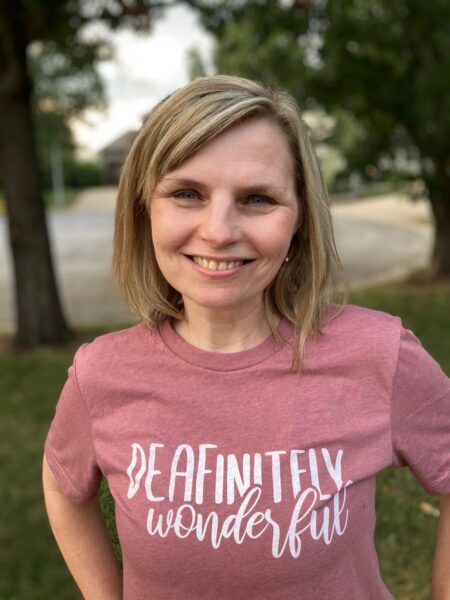
These days, I’m feeling more confident with my CI listening comprehension skills. I started a podcast called Deafinitely Talking, in which I interview other individuals in the Deaf and hearing loss community about their experiences. It is available on YouTube and Spotify. I also blog regularly about my CI experiences.
My future goal is to learn to play the piano, something I’ve wanted to do since childhood. It is now a possibility thanks to better hearing.”
~~~~~~~~~~~~~
About the author
Shanna Groves, M.Ed., is the author of two books, How I Hear: Confessions of a Lip Reading Mom, and serves on the board of the Kansas Commission for the Deaf and Hard of Hearing. Her writing is featured at LipreadingMom.com. You can access her podcast on YouTube and Spotify.
If you or a loved one is experiencing progressive hearing loss, like Shanna, learn how cochlear implants may help.
2 3 4- Nucleus Smart App is available on App Store and Google Play. For compatibility information, visit www.Cochlear.com/compatibility.
- The Bluetooth® word mark and logos are registered trademarks owned by Bluetooth SIG, Inc. and any use of such marks by Cochlear is under license.
- © 2026 Google LLC
- © 2026 Spotify AB